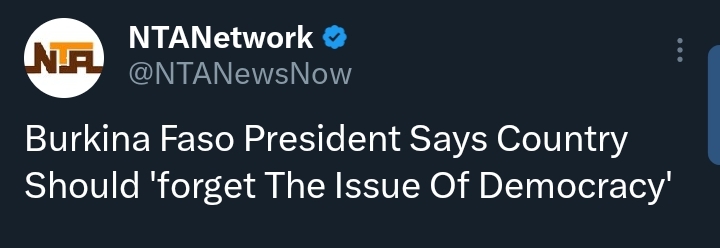
Burkina Faso’s President, Ibrahim Traoré, has stirred fresh debate after declaring that the country should move away from democratic governance, describing it as harmful to national progress.
In a televised interview aired on state media on Thursday, Traoré argued that democracy has failed to deliver stability, insisting that his administration is instead focused on rebuilding the nation through what he described as a “revolutionary” path.
‘Democracy Kills’ — Traoré
Speaking during the interview, the president stated bluntly that Burkina Faso should “forget the issue of democracy,” adding that in his view, “democracy kills” and amounts to “slavery.”
He explained that his government is prioritising what he called “conquest” and “refoundation,” signalling a shift away from earlier commitments to democratic transition.
Traoré had earlier pledged to organise elections by 2024 after seizing power in a 2022 military coup, but recent developments suggest a change in direction.
Political Landscape Shifts in the Sahel
Burkina Faso’s political trajectory mirrors a wider pattern in the Sahel region. The 2022 coup in the country followed a similar takeover in Mali in 2020, and was later echoed by another military takeover in Niger in 2023.
All three nations have since exited the Economic Community of West African States and established a new alliance known as the Alliance of Sahel States.
Military governments in the region initially gained public support by promising to tackle worsening insecurity caused by extremist groups.
Rising Insecurity and Humanitarian Crisis
Despite those promises, the security situation in Burkina Faso remains dire. Armed groups linked to extremist networks continue to operate across large parts of the country.
Estimates indicate that more than 60 per cent of the nation is now beyond government control, highlighting the scale of the challenge facing the ruling junta.
The humanitarian toll has also deepened significantly. Over 2.1 million people have been displaced from their homes, while nearly 6.5 million require urgent humanitarian assistance.
Data from conflict monitoring organisations further suggests that at least 10,600 civilians have been killed since 2016, underlining the persistent violence that continues to grip the country.
Traoré’s latest remarks are expected to intensify both domestic and international scrutiny, particularly as questions grow over the future of governance and stability in Burkina Faso.